
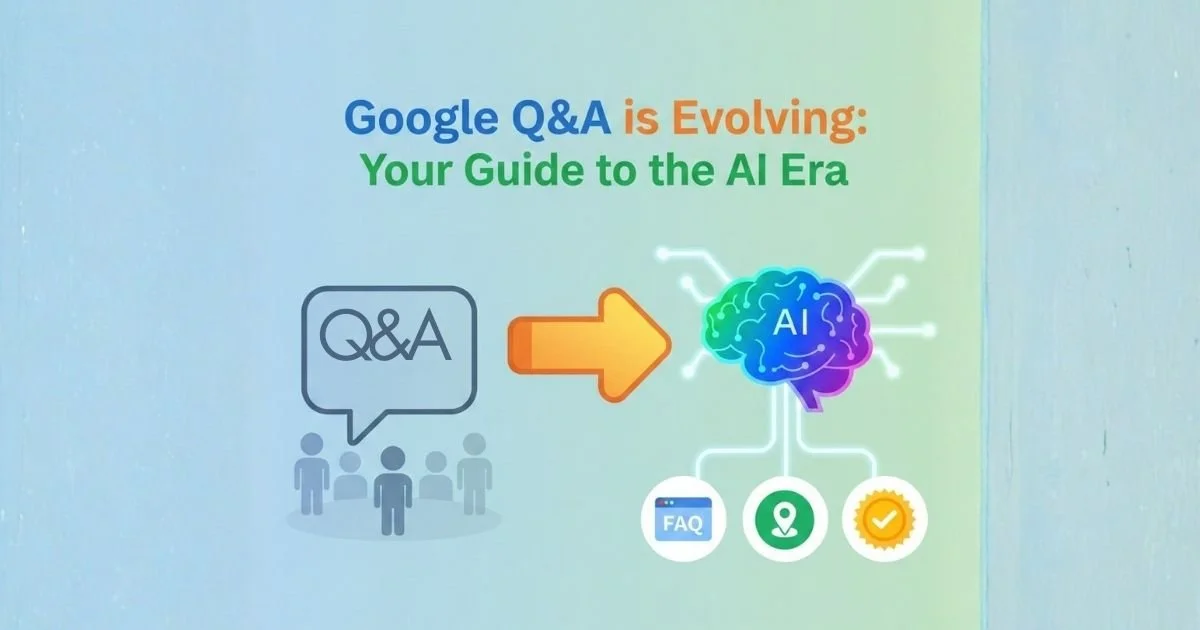
A significant update is reshaping local search. Google is actively phasing out the traditional, user-generated Questions & Answers (Q&A) section on many Google Business Profiles, officially retiring the community-driven Q&A feature.
This change signals a decisive shift towards an AI-powered future, where answers will be generated automatically by systems like the new "Ask this place" feature in Google Maps, powered by Gemini. Additionally, the discontinuation of the Q&A API will take effect on November 3, 2025, further emphasing this transition to AI-driven answers.
This transition moves control from a direct, managed forum to an indirect, automated system. For business owners, understanding this change is critical to maintaining accuracy and visibility in local search results.
Understanding the Shift: From Direct Engagement to AI Synthesis
The old Q&A system functioned as a public bulletin board. Customers could post questions, and businesses or other users could provide answers directly on the profile. While valuable, it was also vulnerable to spam and misinformation.
The new paradigm is fundamentally different. When a user now asks a question about your business in Google Maps or Search, an AI will scan the web to synthesise an answer. It will pull information from your Google Business Profile details, your website, customer reviews, and other online directories. Your ability to influence this answer is no longer about posting in one place, but about ensuring the information it finds everywhere is consistent and correct.
Implications for Your Business
This change carries several important implications:
Loss of a Direct Communication Channel: The Q&A section was a valuable tool for addressing specific customer concerns publicly. That direct line is now closed.
Accuracy Relies on Your Broader Web Presence: An AI-generated answer is only as good as its sources. Inconsistent or outdated information online will lead to incorrect AI answers.
Foundational GBP Data is Paramount: Your core business information—categories, description, hours, services—becomes the primary source AI will reference.
Your Website's Role is Elevated: Your site is now the most authoritative platform you control to publish detailed information that AI can use.
Your Proactive Action Plan for the AI Era
To ensure AI represents your business accurately, you must adopt a holistic approach focused on source management. Here is your actionable strategy.
1. Optimise Your Website as the Primary Information Hub
Your website must become the definitive source for answers. A comprehensive, well-structured FAQ page is now an essential SEO asset, not a nice-to-have.
Create a Detailed FAQ Page: Begin by anticipating every question a customer might have related to your services, particularly those specific to your location. For instance, common inquiries may include your operating hours, service pricing, or details about the services offered in your local area.
Utilise clear and natural language, integrating local keywords such as “[Service] in [Your City]” or “affordable [Service] near [Local Landmark]” to boost your search engine visibility. Organising the information in a user-friendly manner can significantly improve engagement and reduce potential customer confusion.
Salvage Existing Q&As: Don’t overlook the valuable content found in your now-retired Q&As from your Google Business Profile (GBP). These inquiries, submitted by real customers in your community, provide insights into what your audience is genuinely curious about.
Analyse these questions and create dedicated sections in your FAQ that address these recurring themes. For example, you might include questions like, “What is the best way to reach your office located in [Specific Location]?” or “Can I get a quote for [Service] in [Your City]?” By addressing these direct inquiries, you not only enrich your FAQ but also enhance your connection with potential customers.
Implement FAQ Schema Markup: Adding structured data, such as FAQ Page schema, is an effective way to help search engines and AI systems understand and utilise your content. This markup allows for your FAQ information to be presented prominently in search results, increasing your visibility. When implementing this schema, ensure that you incorporate local keywords to further enhance your SEO.
For example, you could format your questions and answers in structured data like this: “What are your operating hours in [Your City]?” with a direct response formatted to provide clarity and conciseness. This not only improves your chances of appearing in rich snippets but also reinforces your credibility as a local authority.
2. Fortify and Maintain Your Google Business Profile
With Q&A gone, every other section of your GBP must be flawless, as it is a primary AI data source.
Achieve 100% Completeness and Accuracy: Meticulously review and update every field. Ensure your business description is detailed, categories are precise, and all services are listed. A single inaccuracy in your listed hours or services can now be propagated directly to potential customers via AI.
Leverage Posts and Visual Content: Regularly use Google Posts to share news, offers, and events. Upload high-quality photos of your location, team, and products. This active engagement signals legitimacy and provides richer context for AI systems.
3. Ensure Universal NAP Consistency and Citation Accuracy
"NAP" stands for Name, Address, and Phone number. Inconsistency across the web confuses both customers and AI, damaging your local search ranking.
Conduct a Citation Audit: Use tools to identify where your business is listed online (directories, review sites, industry listings).
Standardise Your Information: Ensure your NAP details are identical on your website, GBP, and every other directory. Correct any discrepancies immediately.
4. Proactively Monitor and Manage Your Online Presence
The landscape is now dynamic. Adopt a routine to monitor what the AI is saying about you.
Test the New System: Use the "Ask this place" feature in Google Maps for your own business. Ask common customer questions to see what answers are generated.
Trace and Correct Inaccuracies: If you find a wrong AI-generated answer, you must trace its source. Update the incorrect information on your website, GBP, or the relevant directory where the AI sourced it from.
Conclusion: Adapting to the New Fundamentals of Local Search
The retirement of the Google Business Profile Q&A section is more than a feature change; it is a directive to business owners. Success in local search now depends on a strong, consistent, and accurate presence across the entire web—not just on Google.
By elevating your website into a comprehensive information hub, maintaining an impeccable Google Business Profile, and ensuring citation uniformity, you directly influence the AI-generated answers that will represent your business. This shift ultimately rewards those with a disciplined, holistic approach to their online data. For many, managing this broad strategy efficiently necessitates expertise.
Engaging professional SEO services or specialised local SEO services from a reputable SEO services company can provide the technical skill and strategic oversight needed to navigate this transition effectively, ensuring your business continues to thrive in an AI-driven search landscape.