
Beyond Rankings: How AI Conversations Are Redefining Digital Discovery
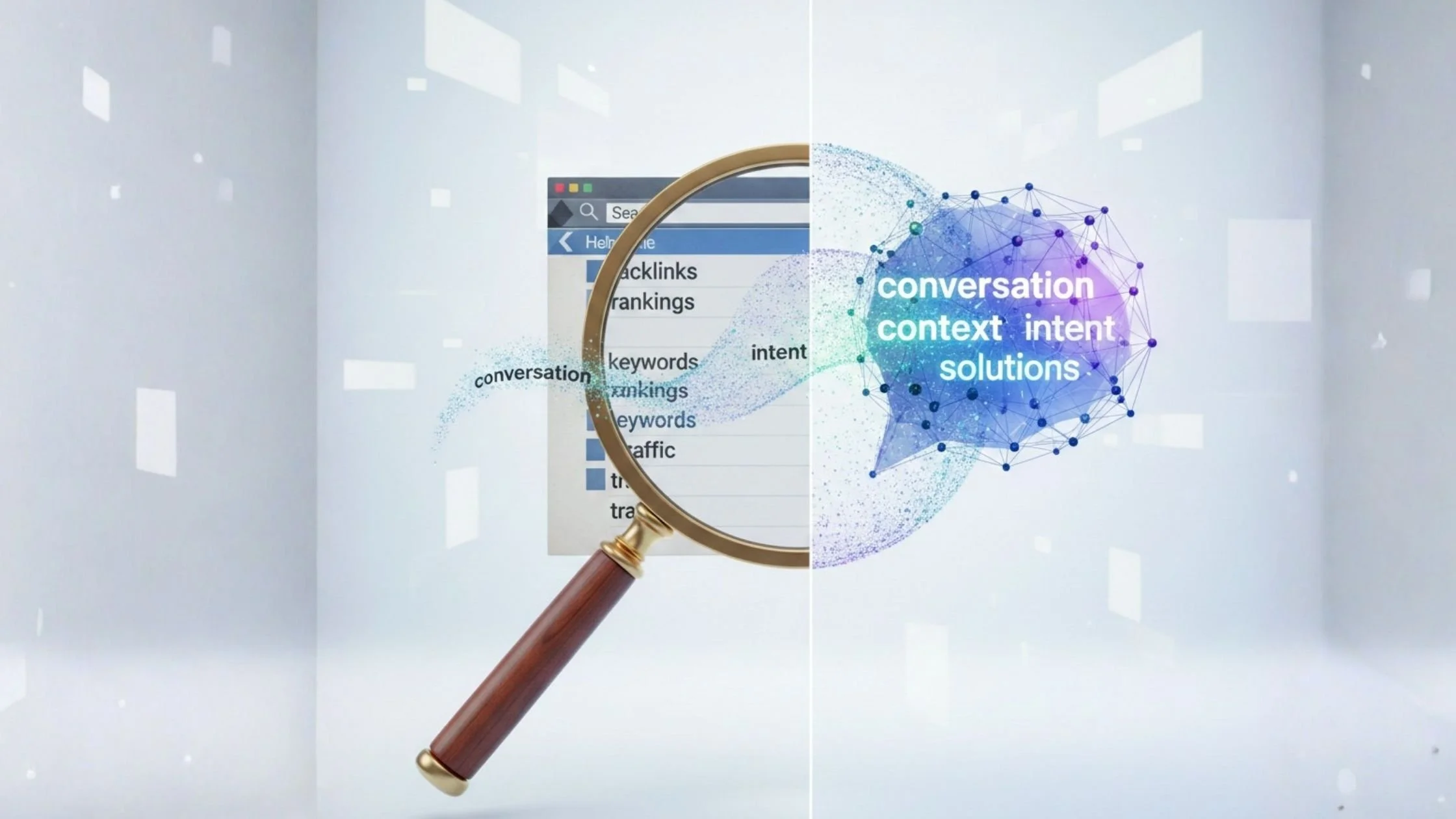
Remember the last time you desperately searched for a solution online? You probably didn't type "best pizza Sydney" into Google. You likely opened ChatGPT or Gemini and asked, "Where can I get authentic Neapolitan-style pizza near Darling Harbour that's good for groups?"
This isn't just a new way to search; it's a completely different paradigm for discovery. For businesses and SEO services everywhere, the game has changed from competing for rankings to competing for presence in a conversation.
We’ve moved past the initial shock of Generative Engine Optimization (GEO) and the tactical shifts it requires. Now, we're facing the broader, more profound implications: AI chatbots and conversational interfaces aren't just changing how we optimise; they're changing why people search and what they expect to find.
The very concept of a "search result" is dissolving into a dialogue, and your digital strategy needs to speak the language.
The End of the Query, The Rise of the Dialogue
Traditional SEO was built on the foundation of the keyword query—a short, often ambiguous string of text. Your entire online presence was a monument to guessing these fragmented phrases. AI search shatters this model by understanding intent, context, and nuance within a full sentence or paragraph.
The impact is two fold.
First, the long-tail keyword isn't just important anymore; it's the only keyword. Every search is now a complex, long-tail conversation.
Second, the user's journey is compressed. They no longer click through 10 blue links to synthesise an answer; they get a consolidated, conversational summary instantly.
This means your professional SEO services provider shouldn't just be tracking rankings; they need to analyse what conversational prompts trigger your brand's mention and whether that mention is helpful, accurate, and authoritative.
From Transactional to Relational: AI as a Curator, Not a Catalog
Think of Google Search as a vast, incredibly fast librarian who could point you to the right book (website). An AI chatbot is like a passionate expert who reads all the books for you, quotes the relevant passages, and explains the concepts in plain language—and often doesn't tell you which books it used.
This transforms your website’s role. It is no longer just a destination; it must become a citable source. The goal shifts from driving a click (transactional) to establishing such undeniable expertise on a topic that the AI has no choice but to reference you as a trusted source (relational). This is where true SEO consulting services need to focus: building your digital profile as a known, reputable entity in your field.
For local SEO services, this is even more critical. When someone asks an AI, "What's a reliable family-run plumber in Canberra who does emergency call-outs?", the AI won't just list businesses with "plumber Canberra" in their title tag.
It will synthesise reviews, service descriptions, content about emergency plumbing, and proximity to determine who is most relevant. Your local SEO must now encompass consistent citations, robust Google Business Profile content, genuine customer testimonials, and locally-focused blog content that answers hyper-specific questions.

Adapting Your Digital Foundation for the Dialogue
In our previous blogs, we discussed the "practical GEO strategies" covered the what, and "GEO rewriting the rules" explained the why. Let's talk about how at a foundational level. How do you structurally adapt?
Architect for Topics, Not Keywords: Reorganise your site’s content into comprehensive topic clusters. Instead of having isolated pages for "affordable SEO services," "best SEO services," and "professional SEO services," create a definitive, linked resource hub around the core topic of "Selecting an SEO Partner." This helps AI understand the depth and breadth of your authority on a subject.
Become the Primary Source: AI models are trained on data. Be the origin of that data. Publish original research, detailed case studies with real data, unique insights from your team's experience, and forward-thinking commentary. This original material is the highest-value fuel for AI and is what will make you a primary source, not just another site republishing the same information.
Optimise for the "Zero-Click" Citation: Assume many users will never click. Ensure your most critical information—your unique value proposition, key differentiators, and location—is clear in the first 100 words of your page and is easily extractable via schema markup. Your meta descriptions are now more important than ever; they might be read verbatim by an AI.
Audit for AI, Not Just Google: Regularly test how major AI models perceive your brand. Use prompts your customers would use and see if you appear, what's said about you, and which competitors are also cited. This "AI reputation audit" is as crucial as a backlink profile check.
Conclusion: The New Measure of Success
The metric of success in the era of AI search is no longer just traffic volume or ranking position. It's citation quality, accuracy, and strategic visibility within the AI conversation. Are you being presented as a solution when it matters most? Is the information about your brand correct and compelling?
The businesses that will thrive are those that stop seeing AI as a threat to their SEO and start viewing it as the ultimate, if demanding, content critic—one that values depth, accuracy, and true expertise above all.
Whether you're a global brand or a local shop, the path forward is to build a digital presence so fundamentally helpful and authoritative that when the conversation happens, you're not just found—you're recommended. This is the new frontier of digital discovery, and it's waiting for your voice.